
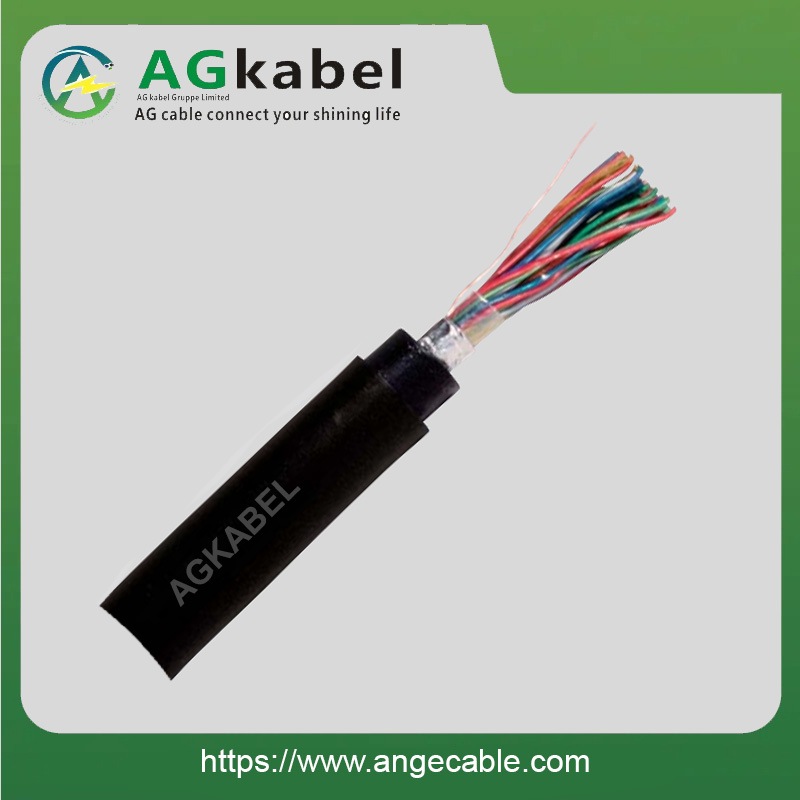
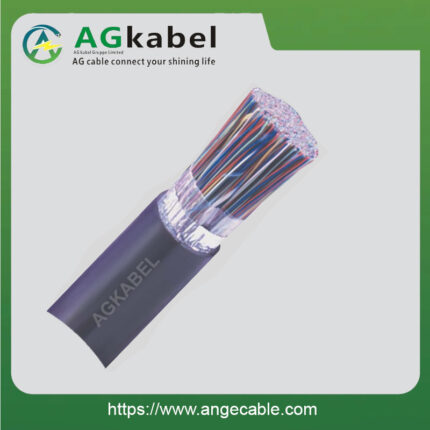
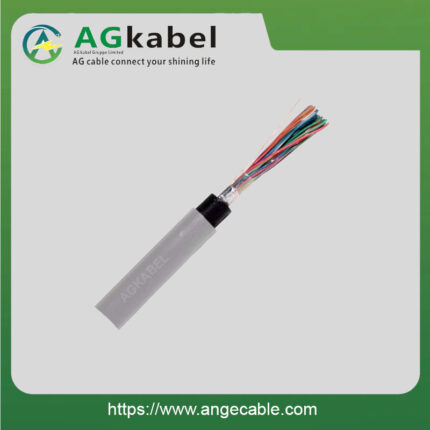
These communication cables are specifically used as connecting cables in local networks and PABX systems for telephone purposes and for the transmission of signals. Because they are suitable for installation in cable ducts, they are highly versatile for structured cabling projects. Furthermore, these cables are not permitted for use as power installations, ensuring safety in their designated applications. Although they may be used in locations with fire and explosion hazards, this is only permitted in accordance with the appropriate safety precautions.
The cable structure features a bare copper conductor with diameters of 0.4 mm, 0.5 mm, 0.6 mm, or 0.7 mm, which is insulated with PE low density. Four wires are twisted into a quad, and 5 quads are twisted to a basic unit. The units are stranded into a cable with a laminated aluminium tape screen, which has a thickness of no less than 0.06mm and is one side coated with copolymer, followed by a laminated copper wire. Finally, the assembly is protected by a PE low density protective sheath containing 2.5% carbon black, providing excellent durability against environmental factors.
Technical Data & Construction Overview:
-
Conductor diameter: 0.4 mm / 0.5 mm / 0.6 mm / 0.7 mm
-
Conductor resistance at 20°C-max: 150 Ω/km / 95 Ω/km / 65 Ω/km / 48 Ω/km
-
Insulation resistance – min: 10 GΩ x km
-
Mutual capacitance at 800Hz-nom: 48 nF/km
-
Capacitance unbalances at 800Hz-max: K1: 980 pF/500m; Ke: 1,500 pF/500m; K9-K12: 50% of all values; K9-K12: 300 pF/500m; 20% of all values; 200 pF/500m
-
Test voltage 50Hz, 2 min: 500V / 2000V
-
Operating voltage peak value: 150V / 220V
-
Temperature range: Laying and installing -10°C up to +60°C; Exploitation and storage -40°C up to +60°C
-
Bending radius, min. approx.: 10 x cable diameter
Cable core construction
| Number of pairs | Number of quads | Number of units in the layers | |||||
|---|---|---|---|---|---|---|---|
| 1-st layer | 5×4 | 2-nd layer | 25×4 | 1-st layer | 50×4 | ||
| 6 | 3 | 3-quads | |||||
| 10 | 5 | 5 | |||||
| 20 | 10 | 5 | 5 | ||||
| 30 | 15 | 5 | 10 | ||||
| 50 | 25 | 5 | 7 | 5 | |||
| 100 | 50 | 3 | 6 | ||||
| 150 | 75 | 3 | |||||
| 200 | 100 | 4 | |||||
| 250 | 125 | 5 | 5 | ||||
| 300 | 150 | 6 | |||||
| 400 | 200 | 8 | |||||
| 500 | 250 | 5 | 5 | ||||
| 600 | 300 | 6 | 6 | ||||
| 700 | 350 | 7 | 7 | ||||
| 800 | 400 | 8 | 8 | ||||
| 1000 | 500 | 10 |
Construction data TPPP…x2x0.4
| Number of pairs | Outer diameter approx. mm | Copper weight kg/km | Cable weight approx. kg/km |
|---|---|---|---|
| 4 | 10.5 | 27 | 108 |
| 6 | 11.3 | 31 | 155 |
| 10 | 12.6 | 51 | 208 |
| 20 | 16.3 | 76 | 268 |
| 30 | 18.3 | 127 | 398 |
| 50 | 21.6 | 211 | 523 |
| 100 | 29.1 | 370 | 918 |
| 150 | 35.5 | 634 | 1400 |
| 200 | 41.1 | 831 | 1900 |
| 300 | 48.3 | 1276 | 2400 |
| 400 | 49.1 | 1503 | 2631 |
| 500 | 60.1 | 1895 | 3252 |
| 600 | 68.1 | 1966 | 3603 |
| 800 | 55.9 | 2538 | 4127 |
| 1000 | 61.1 | 3056 | 4936 |
| 1200 | 73.5 | 4510 | 6597 |
Construction data TPPP…x2x0.5
| Number of pairs | Outer diameter approx. mm | Copper weight kg/km | Cable weight approx. kg/km |
|---|---|---|---|
| 4 | 12.6 | 26 | 149 |
| 6 | 13.0 | 34 | 182 |
| 10 | 14.6 | 43 | 283 |
| 20 | 15.9 | 76 | 305 |
| 30 | 15.9 | 111 | 287 |
| 50 | 22.1 | 203 | 512 |
| 100 | 30.7 | 387 | 950 |
| 150 | 39.0 | 634 | 1300 |
| 200 | 45.7 | 831 | 2035 |
| 250 | 43.7 | 1276 | 2150 |
| 300 | 53.6 | 1685 | 2700 |
| 400 | 59.4 | 2100 | 3350 |
| 500 | 63.5 | 2400 | 4100 |
| 600 | 64.8 | 3100 | 4808 |
| 700 | 67.6 | 3530 | 5450 |
| 800 | 73.8 | 4001 | 6488 |
| 1000 | 73.8 | 4800 | 6468 |
Construction data TPPP…x2x0.6
| Number of pairs | Outer diameter approx. mm | Copper weight kg/km | Cable weight approx. kg/km |
|---|---|---|---|
| 4 | 13.3 | 31 | 198 |
| 6 | 14.6 | 48 | 245 |
| 10 | 16.1 | 72 | 309 |
| 20 | 19.0 | 113 | 438 |
| 30 | 21.1 | 170 | 612 |
| 50 | 26.3 | 269 | 850 |
| 100 | 33.5 | 522 | 1270 |
| 150 | 41.2 | 817 | 1935 |
| 200 | 46.8 | 1133 | 2335 |
| 250 | 43.6 | 1454 | 2520 |
| 300 | 54.0 | 1731 | 3230 |
| 400 | 68.0 | 2500 | 4230 |
| 500 | 60.6 | 3100 | 5440 |
| 600 | 70.3 | 3710 | 6368 |
| 700 | 73.7 | 4101 | 7503 |
| 800 | 81.1 | 5200 | 7609 |
Construction data TPPP…x2x0.7
| Number of pairs | Outer diameter approx. mm | Copper weight kg/km | Cable weight approx. kg/km |
|---|---|---|---|
| 2 | 12.6 | 21 | 131 |
| 4 | 13.6 | 45 | 185 |
| 6 | 16.3 | 76 | 250 |
| 10 | 20.3 | 111 | 458 |
| 20 | 28.4 | 201 | 809 |
| 30 | 34.0 | 300 | 1270 |
| 50 | 42.0 | 500 | 1945 |
| 100 | 58.2 | 1053 | 3533 |
| 150 | 70.7 | 1488 | 5099 |
| 200 | 68.8 | 1998 | 5099 |
| 250 | 74.0 | 2500 | 6178 |
| 300 | 76.2 | 3200 | 7354 |
| 400 | 80.5 | 4200 | 7850 |
| 500 | 81.1 | 5000 | 7859 |
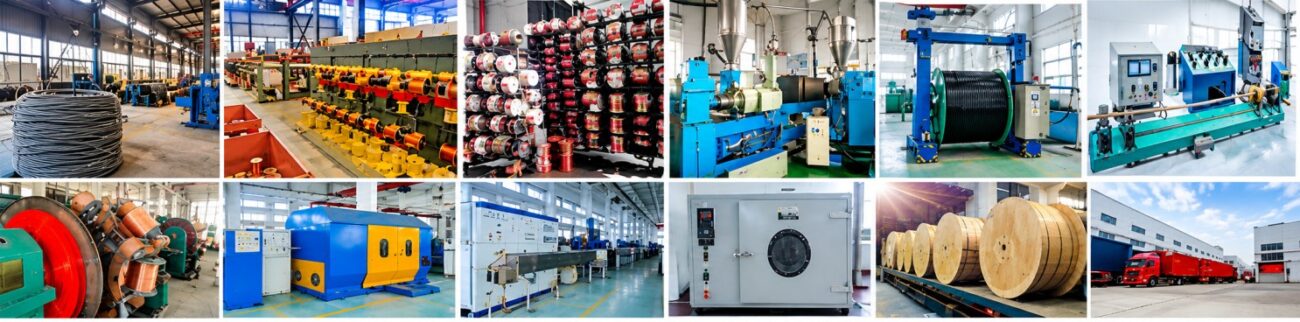
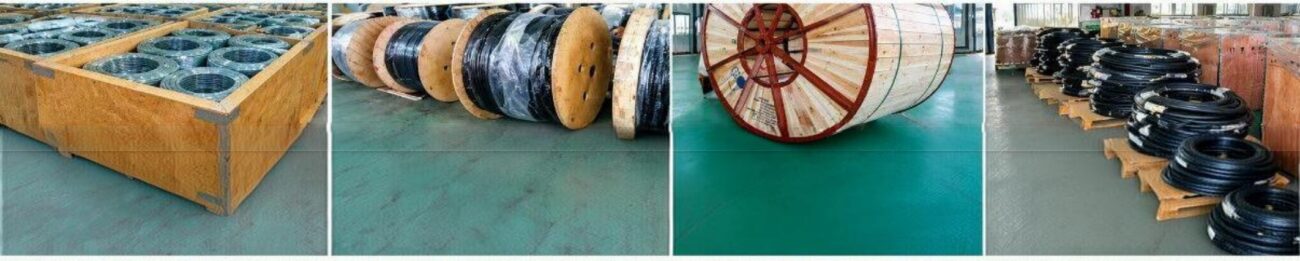
Factory Overview
Packaging & Shipping

Frequently asked questions and answer (Q:- A:-)
Q:- What is the primary application of the TPPP cable?
A:- It is used as connecting cables in local networks and PABX systems for telephone and signal transmission.
Q:- Can this cable be used for power installations?
A:- No, the use of these cables for power installations is explicitly not permitted.
Q:- What conductor diameters are available for this cable?
A:- The cable is available with conductor diameters of 0.4 mm, 0.5 mm, 0.6 mm, and 0.7 mm.
Q:- What is the maximum conductor resistance for the 0.4 mm version?
A:- The maximum conductor resistance is 150 Ω/km.
Q:- How is the cable protected against electromagnetic interference?
A:- It features an aluminium tape screen with a laminated copper wire.
Q:- What is the minimum bending radius for installation?
A:- The minimum bending radius is approximately 10 times the cable diameter.
Q:- What is the temperature range for laying and installing?
A:- The laying and installing temperature range is -10°C up to +60°C.
Q:- What material is used for the outer sheath?
A:- The outer sheath is made of PE low density with 2.5% carbon black.
Q:- How is the color coding structured?
A:- Each unit has a red supporting spiral for counting start and a yellow supporting spiral for counting direction.
Q:- What is the nominal mutual capacitance at 800 Hz?
A:- The nominal mutual capacitance is 48 nF/km.
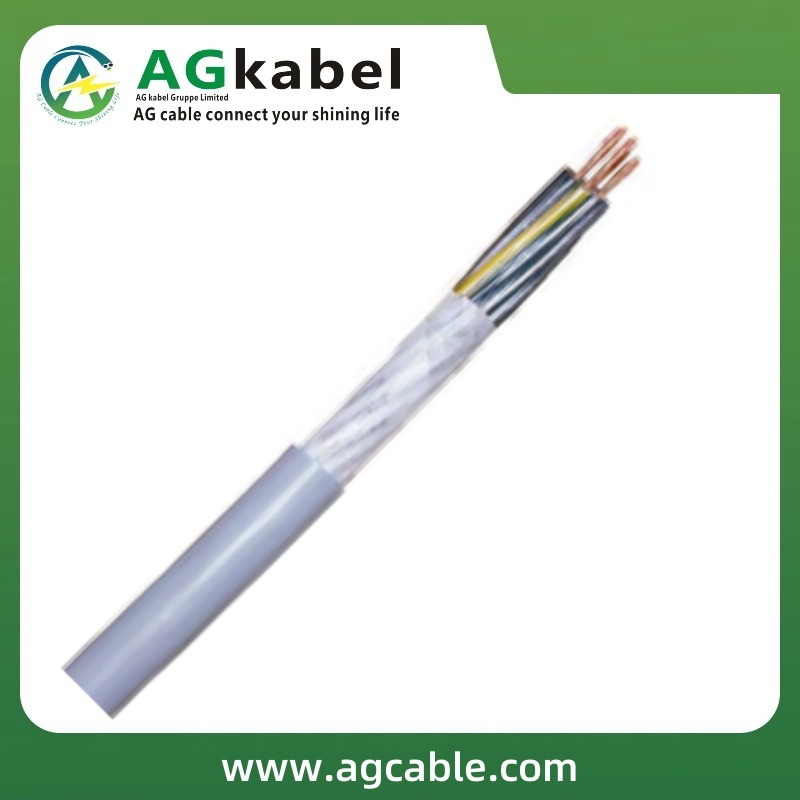
AGKABEL Drag Chain Cables SL-FYY-PVC – Number Coded, Ultraflexible
High-performance ultraflexible control cables designed for continuous flexing in cable trays, machine industries, robotics, and highly mobile machine parts. Compliant with DIN VDE 0245, 0281. Temperature range: -5°C to +70°C (Flexing) | -40°C to +80°C (Fixed). Nominal voltage: 300/500 V. Features a minimum bending radius of 7.5 x cable diameter for long service life. Available from 2 to 25 cores, 0.5mm² to 2.5mm².
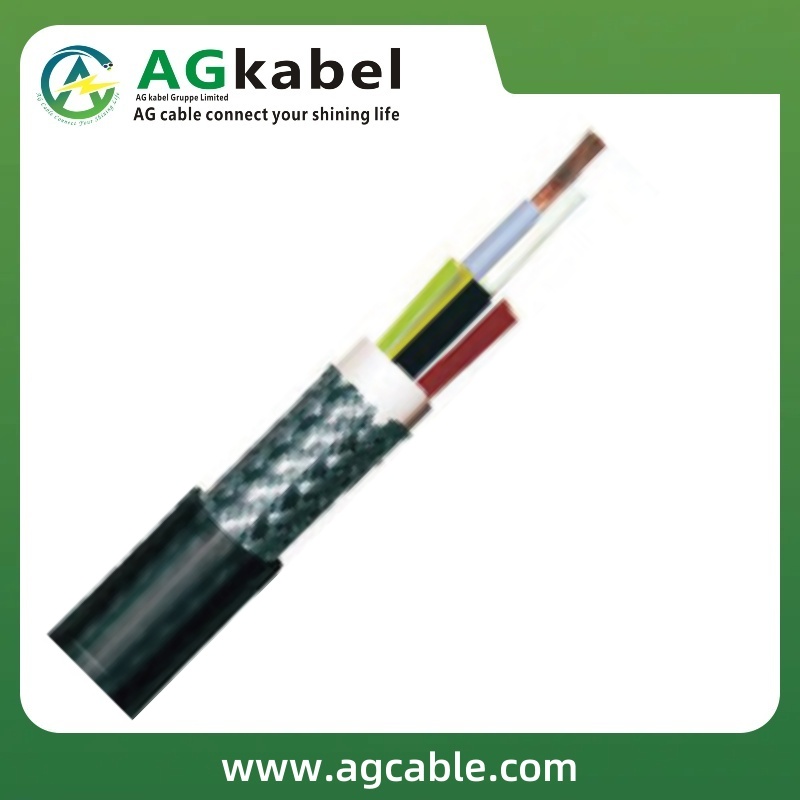
AGKABEL Flexible Control Cables 2YSLCYK-J – 0.6/1 kV, EMC, Double Screened
High-performance motor power supply cable designed for frequency converters to ensure electromagnetic compatibility (EMC). Features double screening (including a concentric copper conductor for enhanced protection) and a transparent outer sheath. Supply and connecting cable for medium mechanical stress in fixed installations, forced movements, and outdoor applications (open air). Suitable for industrial pumps, ventilators, conveyor belts, and air-conditioning installations. Nominal voltage: 0.6/1 kV. Available from 4X2,5 to 4X185, plus hybrid 3X70+3X10.
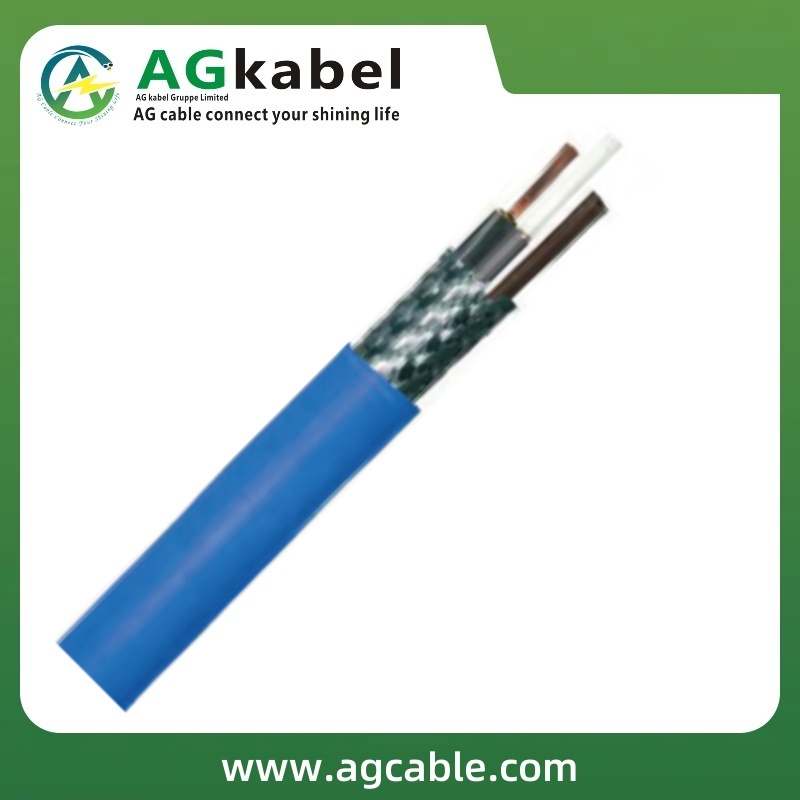
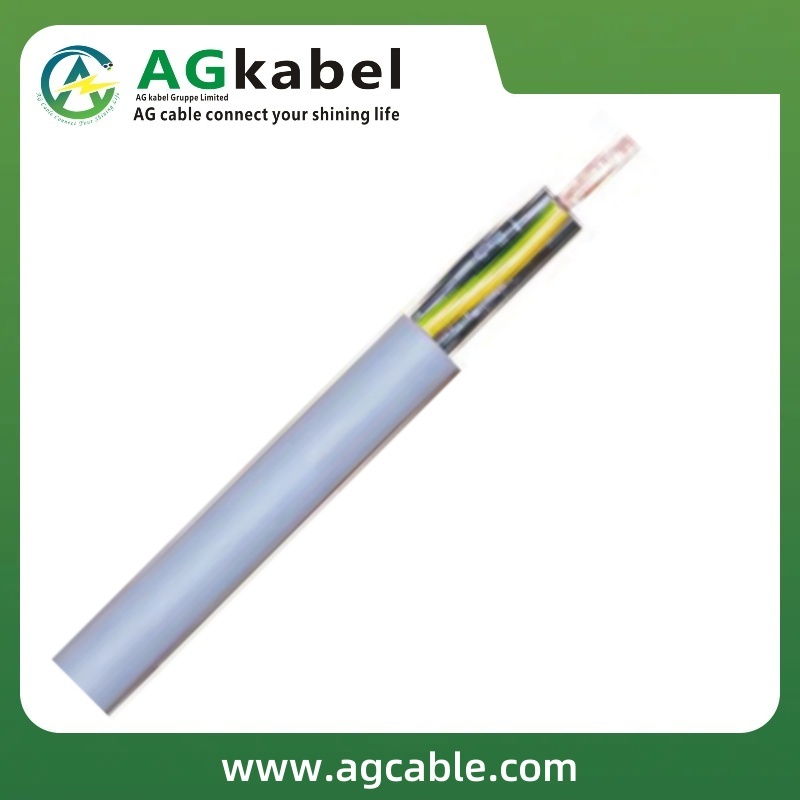
AGKABEL Flexible Control Cables YSLYSY-JZ – Number Coded, Steel Wire Braid
Flexible control and measuring cables designed for tool machinery, plant installations, power stations, and data equipment. Features a galvanized steel wire braid for optimal mechanical protection and corrosion resistance, finished with a transparent outer sheath. Compliant with DIN VDE 0245, 0281, 0293, and 0295. Temperature range: -5°C to +80°C (Flexing) | -40°C to +80°C (Fixed). Nominal voltage: 300/500V. Available from 2 to 61 cores, 0.5mm² to 6.0mm² (larger sizes available on request).
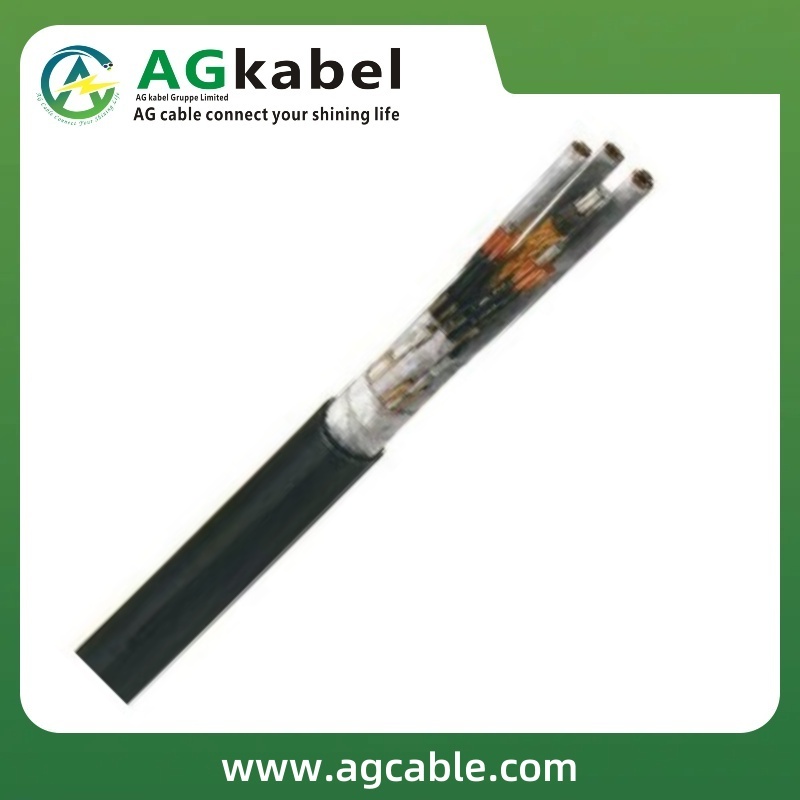
AGKABEL Lift Control Cables YSLTÖ – for Gravity-Fed Collector Basket Operation
Flexible, number-coded feeder cables designed for load-lifting equipment (e.g., spreaders) experiencing high mechanical stress in Gravity-Fed Collector Basket operations. Features a built-in suspension strand for vertical support and is available with or without integrated fibre-optics. Rated for unrestricted outdoor and indoor use, resistant to ozone, UV radiation, and moisture. Temperature range: -20°C to +60°C (Fully flexible/Fixed). Rated voltage: 300/500 V. Available from 20 to 48 cores, 1.0mm² to 3.5mm².
Reviews
There are no reviews yet.