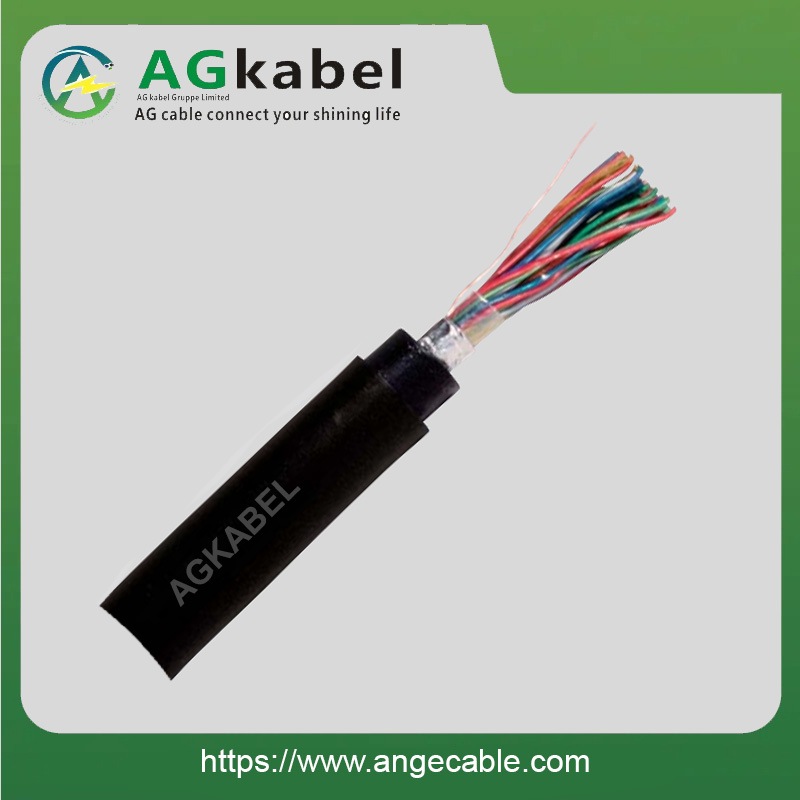
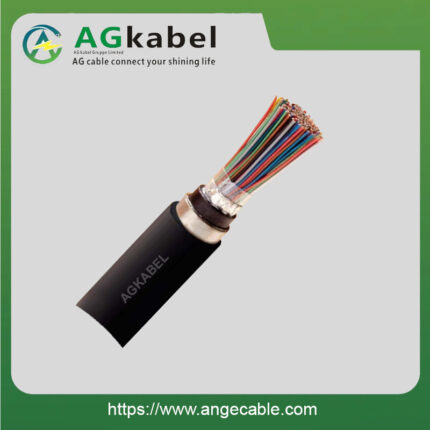
These jelly-filled communication cables are specifically used as connecting cables in local networks and PABX systems for telephone purposes and for the transmission of signals. Because the filling of petroleum jelly does not permit moisture penetration into the cable core, they are exceptionally reliable for underground infrastructure projects. Furthermore, they are suitable for underground installation, in cable ducts, and conduits, making them highly versatile for urban network deployments. Although they may be used in locations with fire and explosion hazards, this is only permitted in conjunction with the appropriate safety precautions. Additionally, the use of these cables for power installations is explicitly not permitted.
The cable structure features a bare copper conductor with diameters of 0.4 mm, 0.5 mm, 0.6 mm, or 0.7 mm, which is insulated with polyethylene insulation type TY2 according to VDE 0207 part 2. Four wires are twisted to a quad, and each 5 quads are twisted to a basic unit. The units are stranded into a compact cable with petroleum jelly and several layers of aluminium tape screen. Finally, the assembly is protected by a PE low density protective sheath containing 2.5% carbon black.
Technical Data & Construction Overview:
-
Conductor diameter: 0.4 mm / 0.5 mm / 0.6 mm / 0.7 mm
-
Conductor resistance at 20°C-max: 150 Ω/km / 95 Ω/km / 65 Ω/km / 48 Ω/km
-
Insulation resistance – min: 5 GΩ x km
-
Mutual capacitance at 800Hz-nom: 55 nF/km
-
Capacitance unbalances at 800Hz-max: K1: 980 pF/500m; Ke: 1,500 pF/500m; K9-K12: 50% of all values; K9-K12: 300 pF/500m; 20% of all values; 200 pF/500m
-
Test voltage 50Hz, 2 min: Wire-wire 500V / Wire-screen 2000V
-
Operating voltage peak value: Cables with cores 0.4 and 0.5mm: 150V; Cables with cores 0.6 and 0.7mm: 220V
-
Temperature range: Laying and installing -10°C up to +60°C; Fixed -40°C up to +60°C
-
Minimum bending radius approx.: 10 x cable diameter
Cable core construction
| Number of pairs | Number of quads | Number of units in the layers | ||
|---|---|---|---|---|
| 5×4 (1st layer) | 25×4 (2nd layer) | |||
| 6 | 3 | 3-quads | ||
| 10 | 5 | 5 | ||
| 20 | 10 | 2 | ||
| 30 | 15 | 5 | ||
| 50 | 25 | 6 | 1 | |
| 100 | 50 | 3 | 7 | |
| 150 | 75 | 3 | ||
| 200 | 100 | 4 |
Cable construction TPJPP…
| Number of pairs | External diameter approx. mm | Copper weight kg/km | Cable weight approx. kg/km |
|---|---|---|---|
| 2x2x0.4 | |||
| 6 | 11.4 | 15 | 120 |
| 10 | 12.1 | 24 | 143 |
| 20 | 15.7 | 73 | 280 |
| 30 | 19.0 | 73 | 408 |
| 50 | 20.5 | 174 | 488 |
| 70 | 25.5 | 174 | 728 |
| 100 | 26.5 | 360 | 923 |
| 150 | 30.5 | 594 | 1293 |
| 200 | 33.6 | 594 | 1261 |
| 2x2x0.5 | |||
| 6 | 12.0 | 23 | 141 |
| 10 | 13.3 | 37 | 178 |
| 20 | 16.3 | 73 | 293 |
| 30 | 18.2 | 113 | 376 |
| 50 | 22.5 | 190 | 573 |
| 70 | 24.6 | 271 | 727 |
| 100 | 30.8 | 382 | 1024 |
| 150 | 33.8 | 592 | 1405 |
| 200 | 39.7 | 782 | 1810 |
| 2x2x0.6 | |||
| 6 | 12.6 | 32 | 170 |
| 10 | 15.6 | 54 | 255 |
| 20 | 18.0 | 101 | 381 |
| 30 | 19.6 | 164 | 502 |
| 50 | 25.0 | 292 | 787 |
| 70 | 25.7 | 382 | 737 |
| 100 | 32.4 | 564 | 1298 |
| 2x2x0.7 | |||
| 6 | 14.2 | 44 | 201 |
| 10 | 16.3 | 70 | 271 |
| 20 | 20.0 | 150 | 468 |
| 30 | 24.5 | 222 | 616 |
| 50 | 30.6 | 394 | 1060 |
| 70 | 33.6 | 532 | 1277 |
| 100 | 39.3 | 768 | 1703 |
Type codes
-
T – telephone cable
-
P – polyethylene insulation
-
J – petroleum jelly filling
-
P – polyethylene sheath
-
P – polyethylene protective sheath
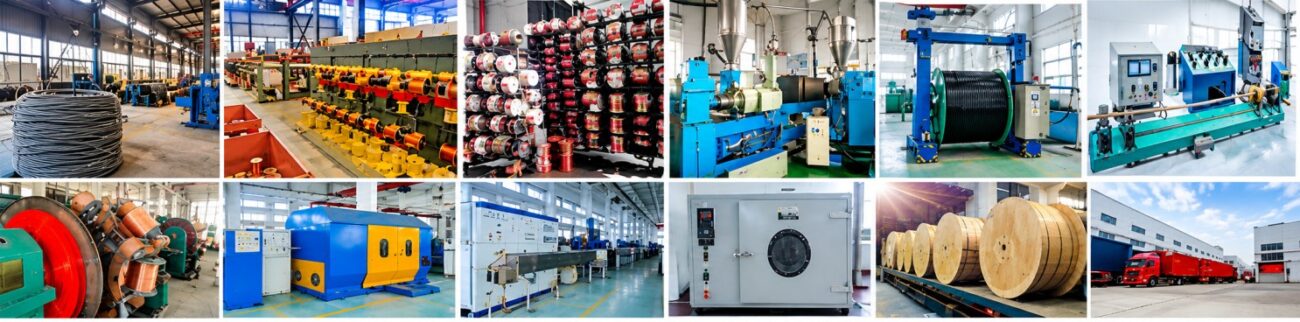
Factory Overview
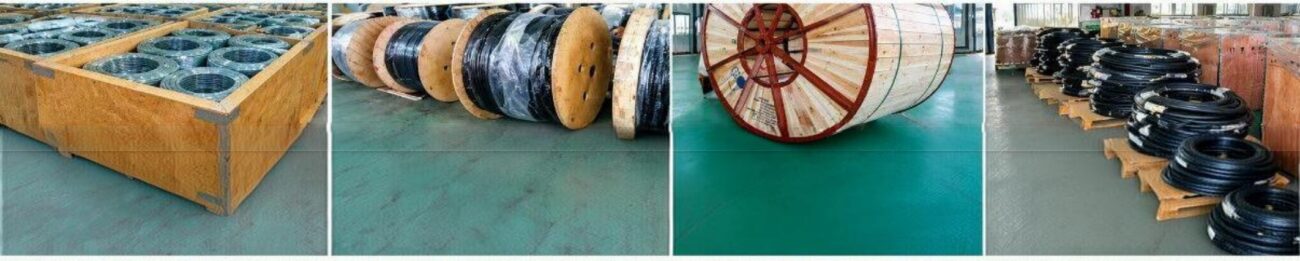
Packaging & Shipping

Frequently asked questions and answer (Q:- A:-)
Q:- What is the primary application of the TPJPP cable?
A:- It is used as connecting cables in local networks and PABX systems for telephone and signal transmission.
Q:- What is the benefit of the petroleum jelly filling?
A:- The jelly filling prevents moisture penetration into the cable core, protecting the cable in underground environments.
Q:- Where is this cable suitable for installation?
A:- It is suitable for underground installation, cable ducts, and conduits.
Q:- Can this cable be used for power installations?
A:- No, the use of these cables for power installations is explicitly not permitted.
Q:- What conductor diameters are available for this cable?
A:- The cable is available with conductor diameters of 0.4 mm, 0.5 mm, 0.6 mm, and 0.7 mm.
Q:- How is the cable protected against electromagnetic interference?
A:- It features several layers of aluminium tape screen.
Q:- What is the minimum bending radius for installation?
A:- The minimum bending radius is approximately 10 times the cable diameter.
Q:- What material is used for the outer sheath?
A:- The outer sheath is made of PE low density with 2.5% carbon black.
Q:- What is the temperature range for fixed installation?
A:- The fixed installation temperature range is -40°C up to +60°C.
Q:- What is the nominal mutual capacitance at 800 Hz?
A:- The nominal mutual capacitance is 55 nF/km.
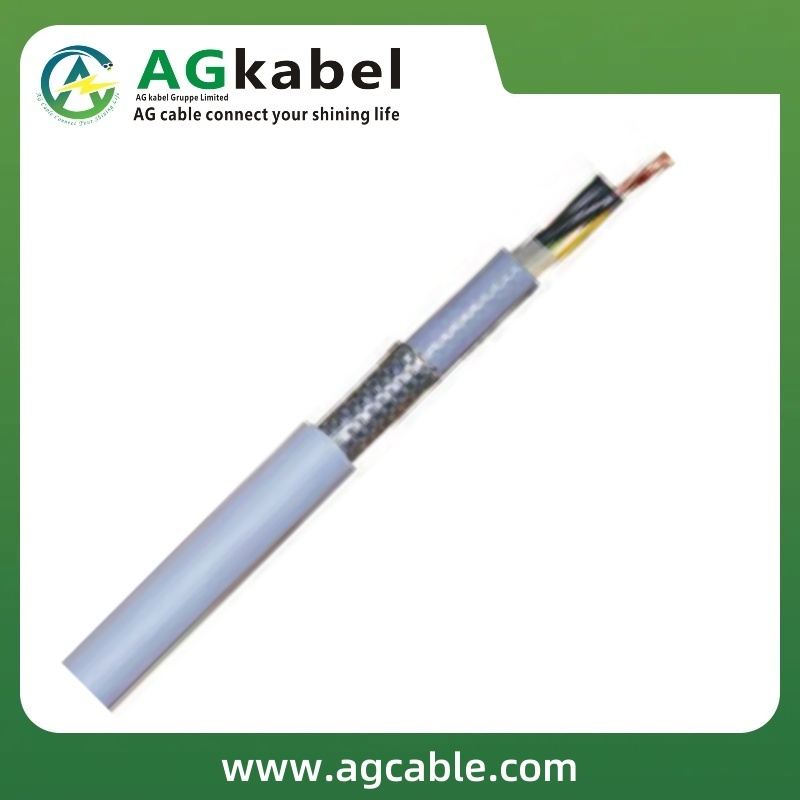
AGKABEL Drag Chain Cables SL-FYY-C11Y-PUR – EMC-type, Cu-screened, Ultraflexible
High-performance ultraflexible control cables designed for continuous flexing in cable trays, machine industries, robotics, and highly mobile machine parts. Features a robust PUR sheath and a braided copper screen for effective protection against internal and external electromagnetic interference (EMC). Compliant with DIN VDE 0245, 0281. Temperature range: -5°C to +70°C (Flexing) | -40°C to +80°C (Fixed). Nominal voltage: 300/500 V. Minimum bending radius: 7.5 x cable diameter. Available from 2 to 50 cores, 0.5mm² to 16mm².
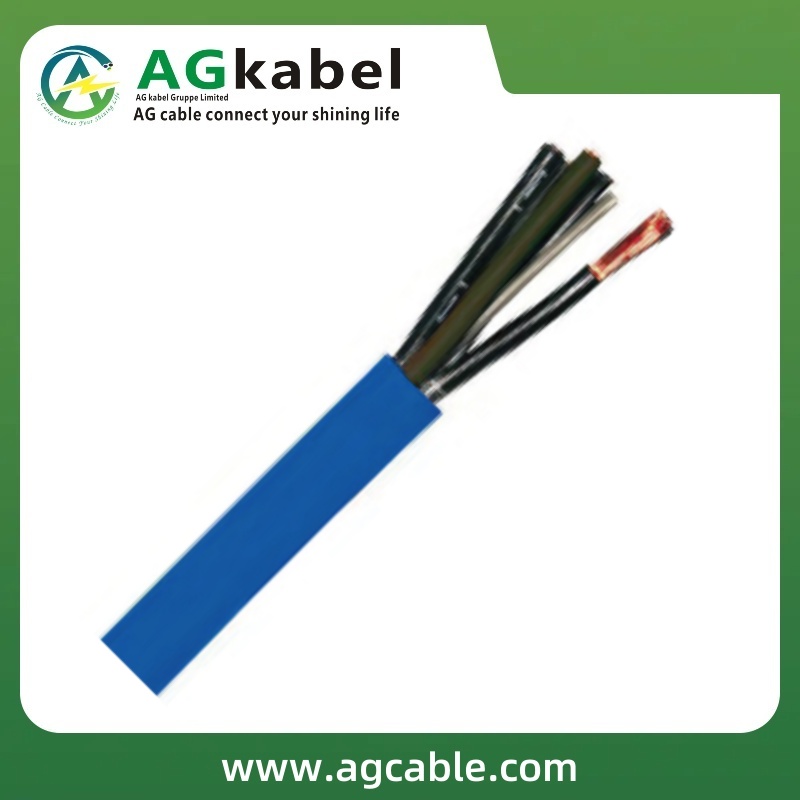
AGKABEL Flexible Control Cables YSLY/EB-OZ – Blue Outer Jacket (Intrinsic Safety)
Number-coded flexible control cables designed for hazardous areas, featuring a special blue outer jacket for intrinsic safety identification. Extensively oil-resistant and not suitable for laying underground. Temperature range: -5°C to +80°C (Flexing) | -40°C to +80°C (Fixed). Nominal voltage: 300/500V. Available from 2 to 100 cores, 0.75mm² to 1.5mm².
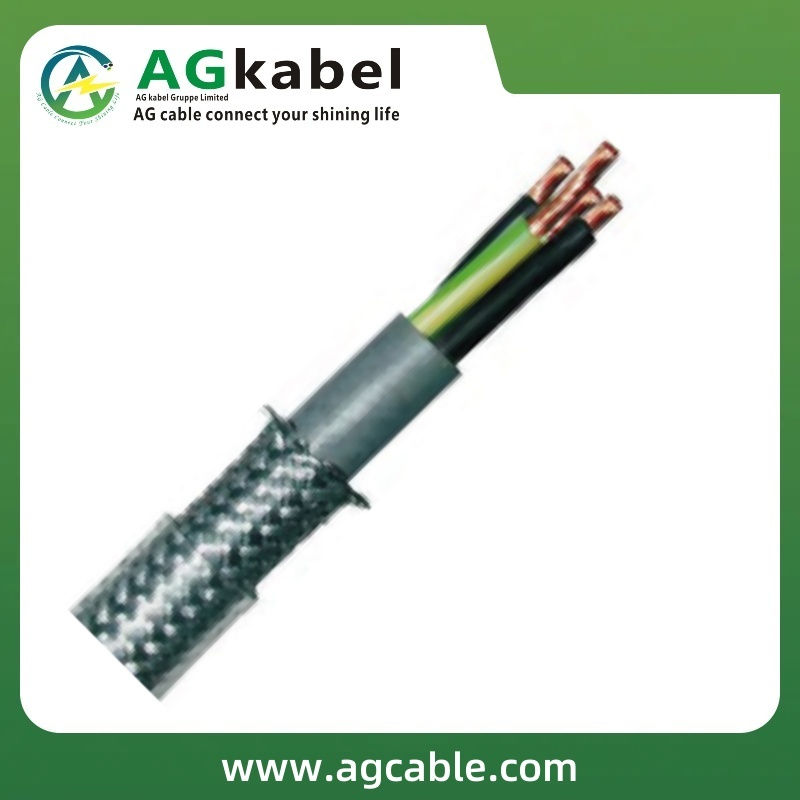
AGKABEL Flexible Control Cables YSLYSY-JZ – Number Coded, Steel Wire Braid
Flexible control and measuring cables designed for tool machinery, plant installations, power stations, and data equipment. Features a galvanized steel wire braid for optimal mechanical protection and corrosion resistance, finished with a transparent outer sheath. Compliant with DIN VDE 0245, 0281, 0293, 0295. Temperature range: -5°C to +80°C (Flexing) | -40°C to +80°C (Fixed). Nominal voltage: 300/500V. Available from 2 to 61 cores, 0.75mm² to 6.0mm².
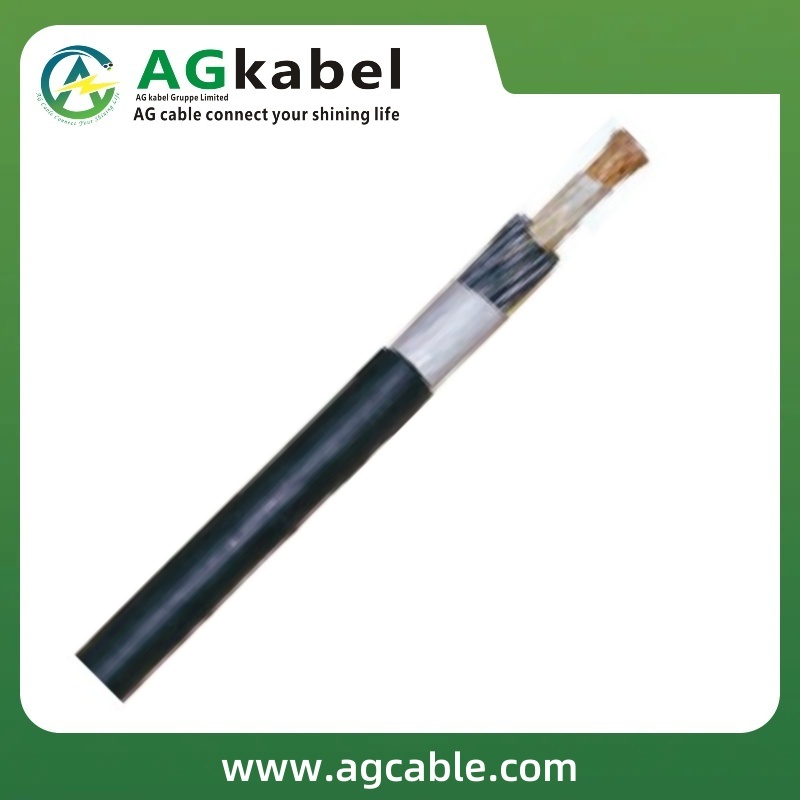
AGKABEL Lift Control Cables STN – Neoprene with Suspension Strand
Robust, weather-resistant control and power cables designed for machines, equipment, and appliances constantly exposed to harsh weather (building machinery, conveyor/hoist systems, dry docks). Features a central strain-bearing support strand, ozone-resistant core insulation, and a chloroprene (neoprene) outer jacket that is hardly flammable and abrasion-resistant. Compliant with DIN VDE 0250 part 807 and DIN VDE 0282. Temperature range: -30°C to +70°C (Flexing) | -40°C to +70°C (Fixed). Nominal voltage: 450/750 V. Available from 3 to 61 cores, 1.0mm² to 16mm².
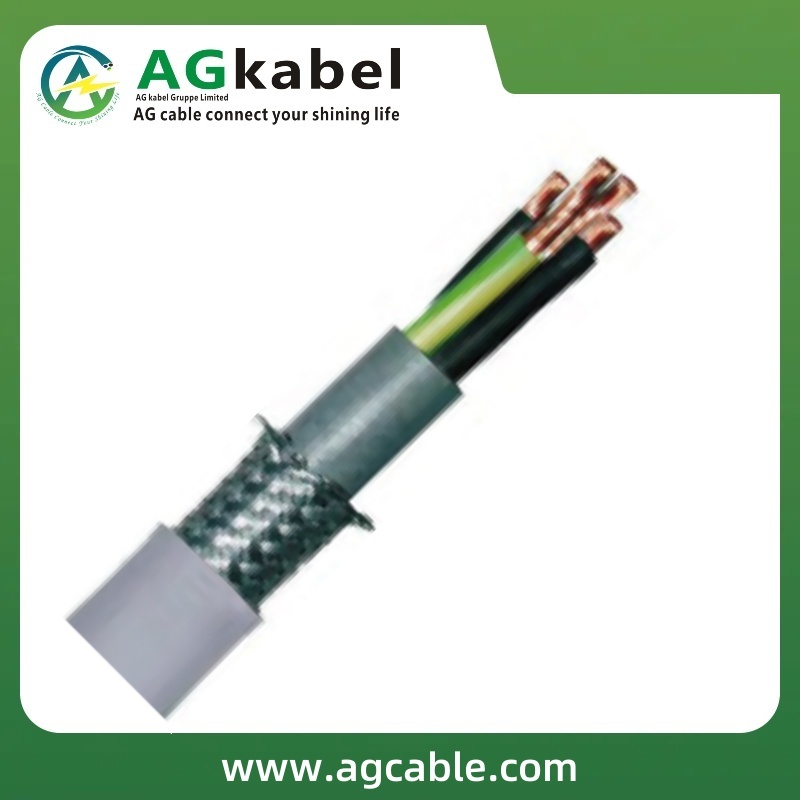
AGKABEL PUR Cables YSL11Y-OZ/JZ – Flexible, Number Coded, Non-Abrasive, Screened
Robust, screened control and power supply cables designed for machine tools and apparatus engineering. Features a durable, non-abrasive PUR outer jacket and overall copper screening for excellent resistance to oil, mechanical stress, and electromagnetic interference (EMI). Suitable for outdoor use under extreme conditions (within the specified temperature range). Temperature range: -5°C to +70°C (Flexing) | -40°C to +80°C (Fixed). Nominal voltage: 300/500 V. Test voltage: 3000 V. Available from 2 to 41 cores, 0.75mm² to 16mm².
Reviews
There are no reviews yet.